Blog: What to do when product velocity breaks the speed of adoption #14220
There are no files selected for viewing
| Original file line number | Diff line number | Diff line change |
|---|---|---|
| @@ -0,0 +1,207 @@ | ||
| --- | ||
| title: What to do when product velocity breaks the speed of adoption | ||
| date: 2025-12-23 | ||
| author: | ||
| - cleo-lant | ||
| featuredImage: >- | ||
| https://res.cloudinary.com/dmukukwp6/image/upload/why_we_killed_our_ai_assistant_9e9565192e.png | ||
| featuredImageType: full | ||
| tags: | ||
| - Product | ||
| - Growth | ||
| crosspost: | ||
| - Blog | ||
| - Founders | ||
| seo: | ||
| metaTitle: 'What to do when product velocity breaks the speed of adoption' | ||
| metaDescription: "When your team ships faster than users can adopt new features, you face a unique challenge. Here's how to balance product velocity with user adoption." | ||
| --- | ||
|
|
||
| Is it possible to ship too much – or too fast? | ||
|
|
||
| Yes. Probably. Unfortunately. | ||
|
|
||
| What used to take a full product org can now be done by a handful of people with good judgment and a lot of tokens. As a result, software powered by LLMs is [cheaper to build](https://martinalderson.com/posts/has-the-cost-of-software-just-dropped-90-percent/) and [scaling faster](https://smartdev.com/ship-product-faster-with-ai-real-data/) than at any point in history. | ||
|
|
||
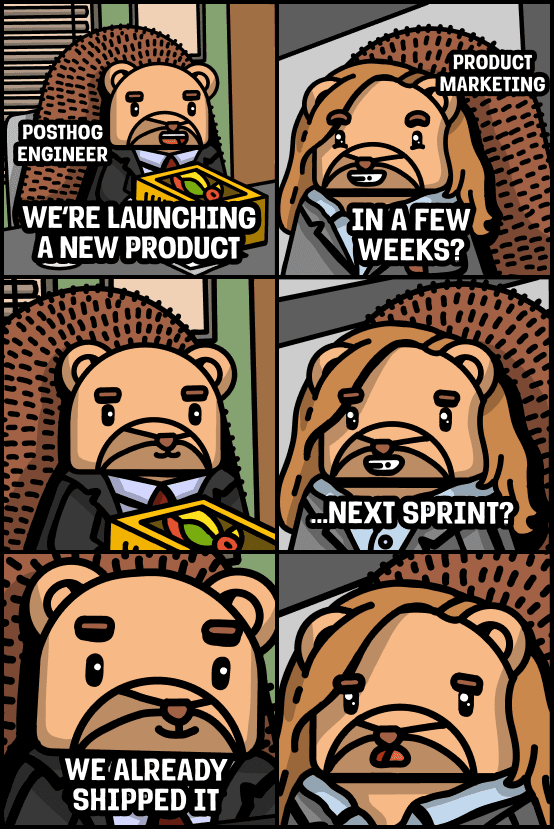
| Take our team at PostHog. With dozens of engineering teams shipping independently, product velocity is extremely high. Once you cross a certain threshold however, that velocity stops compounding and starts competing with itself. | ||
|
|
||
|  | ||
|
|
||
| ## When you ship fast enough, user attention becomes the bottleneck | ||
|
|
||
| Since PostHog is a work tool – not a [lifestyle brand](/merch) – even our most enthusiastic users won’t adopt an infinite number of new things per week. | ||
|
|
||
| In practice, B2B SaaS users tend to adopt: | ||
|
|
||
| - One big new thing every few months | ||
| - A couple of medium improvements | ||
| - A handful of small quality-of-life upgrades | ||
|
|
||
| Everything else gets ignored until someone explains why it matters. This is a classic bottleneck. | ||
|
|
||
| Luckily, bottlenecks have solutions. Manufacturers discovered this and crystallized it in a concept called **Theory of Constraints** (TOC). There's one principle of TOC that is particularly relevant here: | ||
|
|
||
| > When upstream output increases without increasing downstream capacity, the system destabilizes. | ||
|
|
||
| In our case: | ||
|
|
||
| - **Upstream** we have 39 small teams [working asynchronously](/newsletter/how-we-work-async), shipping at a high velocity, and AI accelerating individual productivity. | ||
| - **Downstream** we have limited user attention, comprehension, and engagement capacity. | ||
|
|
||
| TOC can again help us understand the consequences of this mismatched capacity: | ||
|
|
||
| ### 1. Queue buildup | ||
|
|
||
| In manufacturing, this looks like excess inventory. In software, this creates a kind of invisible backlog – work that’s finished on your side, but unfinished in terms of user value. | ||
|
|
||
| The result is diffuse impact: lots of progress shipped, but less progress felt. | ||
|
|
||
| ### 2. Time-to-value increases | ||
|
|
||
| As that backlog grows, the gap between production and adoption stretches. Your team keeps shipping code, but each new capability takes longer to move from available to useful. | ||
|
|
||
| Users struggle to keep up with what’s changed. Support and sales spend more time explaining context. Marketing lags releases instead of amplifying them. | ||
|
|
||
| ### 3. Quality degradation | ||
|
|
||
| When a bottleneck is overloaded, quality degrades through forced tradeoffs. | ||
|
|
||
| In software, that shows up as: | ||
|
|
||
| - Partial adoption instead of full behavior change | ||
| - Misunderstood capabilities | ||
| - Features used narrowly when they were designed to be foundational | ||
|
|
||
| Your product keeps getting bigger and better, but not proportionally clearer. | ||
|
|
||
| ## Does that mean you should slow down? | ||
|
|
||
| No. Maybe? Definitely not. | ||
|
|
||
| Slowing down is what companies do when they run out of ideas (and clearly that's not the problem). Fortunately, the Theory of Constraints is quite explicit about what _not_ to do here: | ||
|
|
||
| > Improving non-bottlenecks is a waste of resources. You improve the system by elevating the bottleneck. | ||
|
|
||
| You could market harder. Push more announcements. Buy more attention. Top-of-funnel always looks good on a dashboard. But adoption still happens one human at a time, and each individual user has a finite amount of mental bandwidth. | ||
|
|
||
| So the real question isn't whether to slow down. It's this: | ||
|
|
||
| **How do you elevate adoption without killing velocity?** | ||
|
|
||
| ## How to address the real bottleneck of user attention | ||
|
Contributor
There was a problem hiding this comment. I think all the examples in this section are great, but I'm missing the context of why the failures are wrong and why the "do this instead" is right. Do we have evidence here? It might be the structure of the sections letting you down, maybe you can do a paragraph and then bullets for "failures" and "do this instead". A structure like this might work better instead:
I'm wary of just saying "everything we do at PostHog is right" if you know what I mean.
Contributor
There was a problem hiding this comment. Basically I think all of these points and examples are great, but there is a bit of context missing from helping them really shine if that makes sense. |
||
|
|
||
| If you’re building anything serious (and using AI to increase throughput), you’ll hit this wall eventually. | ||
|
|
||
| We’re still figuring out what to do about it at PostHog, but directionally this is where the work needs to shift: | ||
|
|
||
| ### 1. Treat attention like a scarce resource (because it is) | ||
|
Contributor
There was a problem hiding this comment. I think the title and first paragraph of this section are great. One challenge I'm having is the bullets are sort of saying "don't do product marketing, do brand marketing instead." I'm wondering if there's more context we could add around how to do product marketing well in this sort of environment. How do you promote specific features/products when users have limited attention? Not at all? We still do launches for PostHog AI, how did we think about that? |
||
|
|
||
| Small teams will naturally optimize for their own product space, but suboptimally for users’ overall cognitive bandwidth. Marketing everything as soon as it’s shipped turns internal velocity into competition for the same slice of user attention (and everyone loses). | ||
|
Contributor
There was a problem hiding this comment. What do you mean by "product space" here? |
||
|
|
||
| **What failure looks like:** | ||
|
|
||
| - Creating elaborate campaigns for every new feature | ||
|
|
||
| - Not having a [launch tier framework](https://aakashgupta.medium.com/the-launch-tier-system-that-transforms-product-teams-fddbb55a785c) | ||
|
Contributor
There was a problem hiding this comment. I'm wondering if this is just an "instead" point. All other points are behavior is the people actually do, but this one is an absence of something making it feel a bit out of place. |
||
|
|
||
| - Email blasting users without [segmentation](https://www.reforge.com/blog/what-is-user-segmentation) | ||
|
|
||
| - Producing lengthy demo videos that are sincere-but-forgettable | ||
|
|
||
| - Marketing on the same exhausted channels as everyone else ([every marketing channel sucks right](https://andrewchen.substack.com/p/every-marketing-channel-sucks-right)) | ||
|
|
||
| **Do this instead:** | ||
|
|
||
| - Making [human-centric](https://www.youtube.com/watch?v=QeU5MmpqBg0&list=PLnOY1RYHjDfw2joBxUPADaadeX5IradbH&index=2), [absurd](https://www.youtube.com/watch?v=EXisgy6eWJ0&list=PLnOY1RYHjDfw2joBxUPADaadeX5IradbH&index=4), entertainment-first content | ||
|
|
||
| - [Partnering with people](https://www.linkedin.com/feed/update/urn:li:activity:7401713037386379265) and brands who have mindshare and trust with your ICP | ||
|
|
||
| - Building [cool things](/deskhog) that delight your target audience without selling your product | ||
|
|
||
| - Turning internal jokes into [public canon](https://www.youtube.com/watch?v=_eLZqBVkxCc&list=PLnOY1RYHjDfw2joBxUPADaadeX5IradbH&index=3) | ||
|
|
||
| - If you’re doing founder-led marketing, [committing to the bit](https://www.linkedin.com/in/j-hawkins/) | ||
|
|
||
| - [Designing a world](https://www.linkedin.com/posts/lottiecoxon_i-was-unsure-how-to-promote-that-we-are-now-activity-7368966636244049920-S3mU) (not a funnel) that people want to live in, and let them [explore it](https://x.com/MichaelAshmead/status/1966136656265687134) when they have the context to care | ||
|
|
||
| ### 2. Sequence launches based on user capacity, not team readiness | ||
|
|
||
| Marketing everything as soon as it’s shipped turns internal velocity into competition for the same slice of user attention (everyone loses). | ||
|
|
||
| **What failure looks like:** | ||
|
|
||
| - Treating launches as [outputs instead of outcomes](https://productschool.com/blog/analytics/output-vs-outcome) | ||
|
|
||
| - Existing users experiencing [feature fatigue](https://www.linkedin.com/pulse/feature-fatigue-love-focus-derek-francis-mezxc/), and new users with release whiplash | ||
|
|
||
| - Expecting documentation to do the heavy lifting of product education | ||
|
|
||
| - Highlighting the what more than the why (*marketing [features > benefits](https://posthog.com/newsletter/marketing-for-devs) is typically a good move if you’re marketing to developers, but overindexing on ‘what’ makes adoption someone else’s problem) | ||
|
|
||
| **Do this instead:** | ||
|
|
||
| - Classifying launches as _events_ or _infrastructure_: If it’s an event, treat it like the [biggest event of the year](https://www.linkedin.com/feed/update/urn:li:activity:7398759974686076928) | ||
|
|
||
| - Insteading of one-off updates, invest in producing a [narrative series](https://www.youtube.com/playlist?list=PLnOY1RYHjDfxcuWI_L1xwuhoXAsxR59VL) that users can follow | ||
|
|
||
| - Encouraging engineers to [do support](/newsletter/engineers-do-support) and see first-hand where users get stuck | ||
|
|
||
| ### 3. Build discovery into the product | ||
|
|
||
| If realizing value requires explanation outside the product, you haven't removed the adoption bottleneck – you've just moved it downstream to marketing, sales, or support. | ||
|
|
||
| **What failure looks like:** | ||
|
|
||
| - Treating external platforms as your main discovery engine (performative presence on Product Hunt, G2, Hacker News may not be [worth it](https://news.ycombinator.com/item?id=29864157)) | ||
|
|
||
| - Relying on social media and emails broadcasts to communicate everything you shipped this week | ||
|
|
||
| - Disrupting the in-app experience with too many tooltips, banners, modals and popups | ||
|
|
||
| - Adding so much to the UI that it subtracts from [user experience](/blog/redesigned-nav-menu) | ||
|
|
||
| **Do this instead:** | ||
|
|
||
| - Defining [activation criteria](/product-engineers/activation-metrics) for new products, and track user behavior over time | ||
|
|
||
| - Leveraging AI to surface features when a user is already doing the related job | ||
|
|
||
| - Embedding docs within your product to keep users in flow (linking to an external help center is a form of context switching) | ||
|
|
||
| - Leveraging habit loops (trigger → action → reward → reinforcement) and other [PLG](https://productled.com/blog/product-led-growth-framework-for-saas-companies) tactics to keep users engaged | ||
|
|
||
| - Committing to [continuous discovery](https://www.youtube.com/watch?v=9RFaz9ZBXpk). Let user feedback and behavior influence what gets amplified next | ||
|
|
||
| ### 4. Measure learning, not just usage | ||
|
|
||
| Adoption doesn’t really start with features. It starts with people getting better at their jobs. That’s why a lot of our marketing content isn’t really about PostHog at all – it’s about [how to be a better product engineer](https://newsletter.posthog.com/). | ||
|
|
||
| **What failure looks like:** | ||
|
|
||
| - Overemphasizing vanity metrics like clicks, impressions, and daily active users (DAU) | ||
|
|
||
| - Incentivizing your product team to be a [feature factory](https://xenoss.io/blog/product-velocity-trap-solutions) instead of taste makers | ||
|
|
||
| - Publishing content that only talks about your product – instead of the market, community, and problems your users actually think about | ||
|
|
||
| - Believing other people care about your product as much as you do (they don’t) | ||
|
|
||
| **Do this instead:** | ||
|
|
||
| - Publishing [learnings](/blog/8-learnings-from-1-year-of-agents-posthog-ai), [works-in-progress](/blog/multi-modal-llm-user-behavior-analysis), and durable mental models that are useful with, or without, your product | ||
|
|
||
| - Teaching others about your domain (HubSpot teaches you how to be a [better marketer](https://blog.hubspot.com/), Figma teaches you how to be a [better designer](https://www.figma.com/blog/insights/)) | ||
|
|
||
| - Sharing uncomfortable things like [postmortems](/blog/nov-24-shai-hulud-attack-post-mortem) for incidents | ||
|
|
||
| - Being a good citizen, [create space](/handbook/people/hogpatch) for others to thrive, help developers (or whichever community you market to) without asking for anything in return | ||
|
|
||
| - Turning internal knowledge into [public artifacts](/handbook) and give space for every role to author content that matters to them | ||
|
|
||
| ## Fast, not frantic | ||
|
|
||
| It's tempting to treat “shipping too fast” as a humblebrag, but that’s lazy thinking. If users can’t adopt what you ship, it’s not velocity – it’s waste. | ||
|
|
||
| Practically, that means you need to be explicit about what matters, do things that would make normal SaaS companies nervous, get better at sequencing the big launches, make a select number of things very loud, and let everything else be quietly excellent. Doing this right helps velocity convert to value. | ||
|
|
||
| <NewsletterForm /> | ||

Uh oh!
There was an error while loading. Please reload this page.