Visualization of relations between one OHS and multiple consumers #13

Description

When modeling three contexts ContextA, ContextB, ContextC with ContextA providing an OHS ServiceA to both ContextB and ContextC where the relationships ContextA -> ContextB and ContextA -> ContextC have the same name I would have expected a context map diagram with one OHS on ContextA with edges to both ContextB and ContextC to make it obvious that both consumers consume the same OHS.
Instead, the context map diagram shows ContextA with two OHSs, one for each relation.
I'm not sure whether this is intended behavior and just a misunderstanting of the visual notation on my side or a bug / due to limitations of how graphviz renders edges between nodes when no port is specified.
Here's an example:
ContextMap Demo {
	contains ContextA
	contains ContextB
	contains ContextC

	ContextA [U,OHS]->[D,CF] ContextB : ServiceA
	ContextA [U,OHS]->[D,CF] ContextC : ServiceA
}

BoundedContext ContextA
BoundedContext ContextB
BoundedContext ContextC
Expected result:

Actual result:

A similar behavior can be observed when exporting to PlantUML where two interfaces for ServiceA are generated with one of them being referenced by ContextB and one by ContextC.
Expected result:

Actual result:

Interestingly, the DDD sample linked from the examples page shows the visualization I would have expected.
Context map in the documentation:
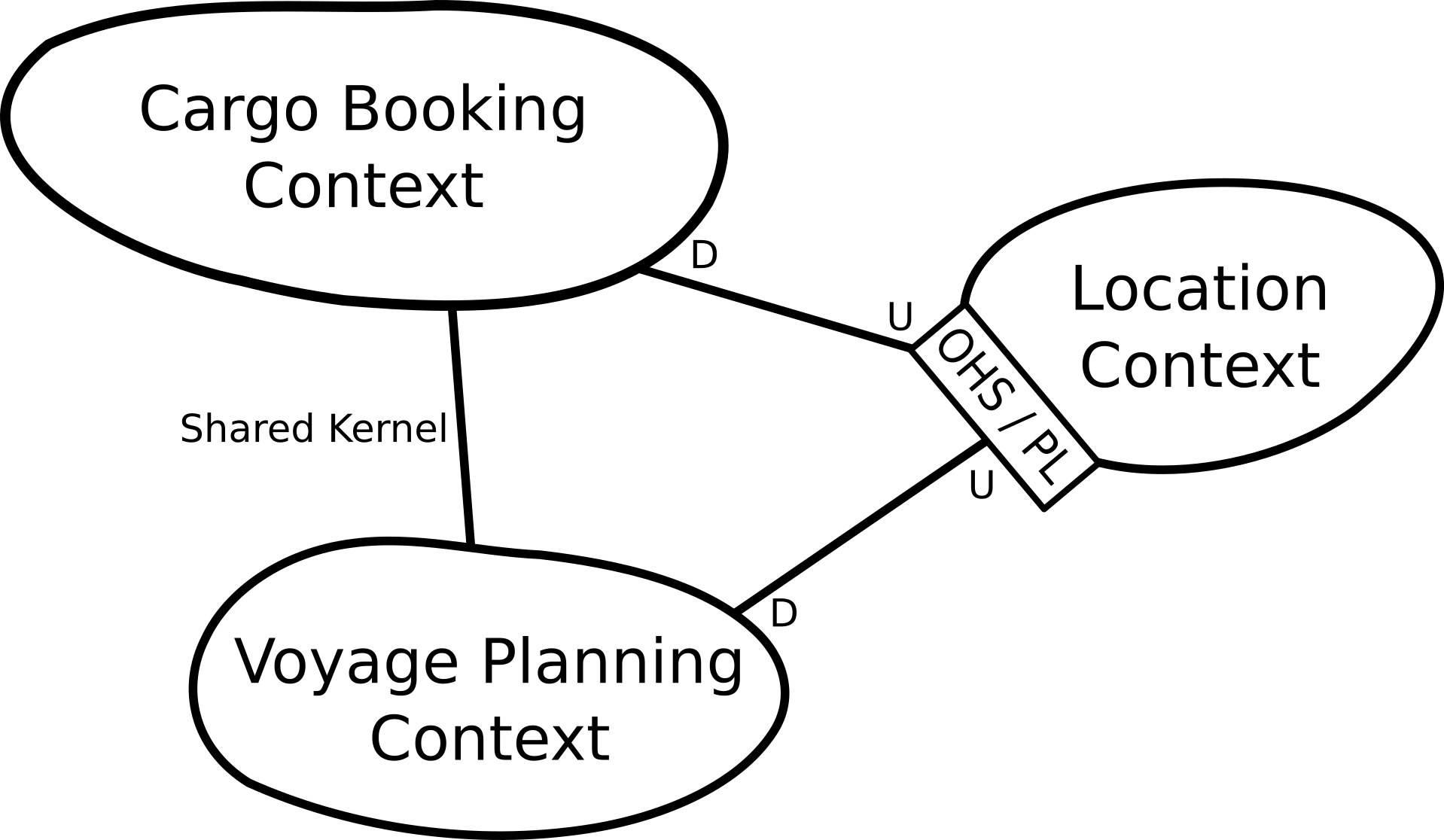
Context map when generated from the stage 5 source of the sample using the contextmapper vscode plugin version v6.5.1 (operation "Generate Graphical Context Map"):
